Turn AI into a patient tutor, conversation partner, and study coach for any language
21 bite-sized sections
6 min read
Free, no signup
Short answer
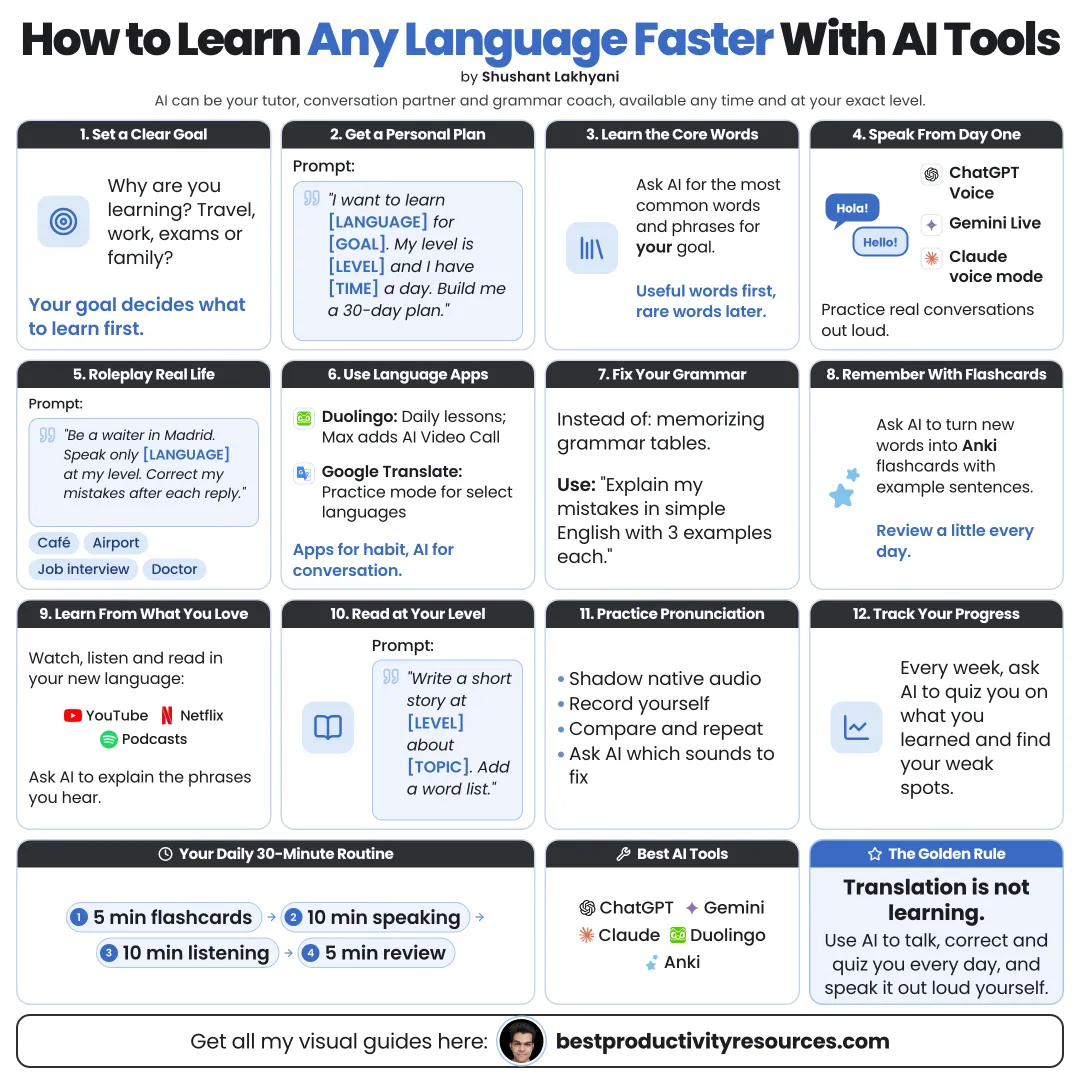
A free guide to learning any language faster with AI tools in 2026: set a goal, build a daily routine, practice speaking with ChatGPT, Gemini, and Claude voice modes, use Google Translate Practice and Duolingo, spaced repetition, reading, listening, writing feedback, prompts, and what to verify.
Most learners do not quit for lack of apps. They quit because they speak too little, get too little feedback, and have no routine.
Unlike a standard app, an AI tutor can:
Talk with you anytime, at your level
Correct your mistakes and explain each one
Build lessons around topics you care about
Simplify any text to match your level
Role-play real-life situations
Track the mistakes you keep repeating
Quiz you on what you have learned
AI gives you unlimited practice. Progress still depends on practicing every day.
02
Follow the language learning loop
Input
Read and listen to plenty of material you mostly understand.
Practice
Speak and write every single day.
Feedback
Get corrections along with explanations.
Review
Review words and mistakes with spaced repetition.
Use
Put the language to work in real situations.
03
Set a clear goal
Decide why you are learning and your deadline:
Travel conversations within three months
A job interview held in the language
Conversations with family
An exam such as DELE, DELF, JLPT, or HSK
Books or shows without subtitles
Help me set a realistic [language] goal. My level is [level], I can study [minutes] a day, and I want to [goal] by [date]. Give me a weekly plan.
04
Find your level
Ask an AI tutor to assess you with:
A short conversation in the language
Questions that get harder until you start to struggle
A brief reading and listening check
An estimate on the CEFR scale, from A1 to C2
Treat the estimate as a starting point, not as an official result.
05
Build a daily routine
Ten minutes
Review your flashcards
Ten minutes
Talk with an AI voice tutor
Ten minutes
Read or listen to content at your level
Five minutes
Write a few sentences and get them corrected
Thirty-five focused minutes a day beat three hours once a week.
06
Speak from day one
Use a voice mode, such as ChatGPT Voice, Gemini Live, or Claude’s voice mode, to:
Hold short conversations every day
Practice introductions and small talk
Ask for slow, simple speech
Ask for repetition or rephrasing
Switch to your native language when stuck
Talk with me in simple [language] at A2 level. Speak slowly. After each of my answers, briefly correct one important mistake, then keep the conversation going.
07
Role-play real situations
Ordering food
Checking into a hotel
Asking for directions
Seeing a doctor
A job interview
Meeting your partner’s family
A phone call to a company
Have the AI play the other person, and repeat the scene until it feels easy.
08
Get feedback on every mistake
Request corrections in a clear format:
Your original sentence
The corrected version
A brief explanation
A more natural phrasing
Two new examples of the same rule
Keep a running list of mistakes you repeat, and review it weekly.
09
Use dedicated learning apps
Google Translate Practice
A beta mode with tailored speaking and listening practice plus feedback, for selected language pairs where available.
Duolingo
Structured lessons and streaks, plus AI features such as roleplay and video calls on its Max plan where available.
Anki
Free spaced-repetition flashcards for long-term recall.
Pair one structured app with one AI tutor. More apps usually means less practice.
10
Learn the vocabulary that matters
Start with the most frequent words
Pick words from your own life and goals
Learn whole phrases, not isolated words
Add example sentences and audio
Review with spaced repetition
Create 20 flashcards for [topic] at [level] in [language]. Include the phrase, its translation, an example sentence, and a pronunciation note. Format them for Anki import.
11
Read at your level
Ask AI to:
Write short stories about your interests at your level
Simplify news articles for you
Add a glossary of new words
Ask you comprehension questions
Raise the difficulty step by step
Pick material where you know most of the words. Too hard discourages you. Too easy teaches little.
12
Listen every day
Podcasts made for learners
Shows with target-language subtitles
YouTube channels about your hobbies
AI-generated dialogues read aloud
Audio overviews of your notes in Gemini Notebook, where your language is supported
Paste a transcript into an AI tool and have it explain the parts you missed.
13
Sharpen your pronunciation
Shadow native audio: listen, then repeat right away
Record yourself and compare
Ask AI which sounds are hardest for speakers of your language
Drill minimal pairs
Ask a voice tutor which of your words were unclear
AI pronunciation feedback can be imperfect. Native speakers are the final test.
14
Write and get corrected
Write something daily:
A short journal entry
A message to a friend
A summary of something you read
Answers to exam-style questions
Have AI correct it, explain the main errors, and rewrite it one level higher.
15
Learn grammar when you need it
Skip memorizing every rule up front. When a pattern confuses you, ask:
Explain [grammar point] in [language] simply, with five everyday examples, the most common learner mistakes, and a short quiz.
16
Practice with real people
Language exchange partners
Online tutors
Local meetups
Friends and family who speak it
Communities built around your hobbies
Prepare with AI. Practice for real with people.
17
Track your progress
Minutes practiced each week
Words and phrases reviewed
Conversations held
Repeated mistakes fixed
One recorded speaking sample each month
Compare this month’s recording with last month’s. You hear progress more easily than you feel it.
18
Try these ten prompts
“Have a five-minute conversation with me in simple [language] about my weekend.”
“Correct this paragraph and explain my three biggest errors.”
“Play a waiter at a café in [city]. I will order.”
“Write a 200-word A2-level story about [interest], with a glossary.”
“Quiz me on the words from our previous session.”
“Explain how [word] differs from [word], with examples.”
“Give me ten phrases I will need for [situation].”
“Rewrite this article as an easier B1-level version.”
“Which mistakes do [native language] speakers usually make in [language]?”
“Build a seven-day plan to prepare for my trip to [place].”
19
Split the work between AI and you
AI handles
Conversation practice, corrections, explanations, level-matched content, flashcards, and quizzes.
You handle
Showing up every day, speaking aloud, reviewing, holding real conversations, and checking important facts.
20
Verify what matters
AI can get grammar or usage wrong, especially in less common languages
Check key phrases with a native speaker or a trusted dictionary
Use official materials to prepare for exams
Learn regional differences, such as Spanish in Spain versus Mexico
Keep private information out of practice conversations
21
Use a master tutor prompt
Act as my personal [language] tutor.
My native language: [language]. My level: [level]. My goal: [goal] by [date]. I can study [minutes] a day.
In every session: open with a short review of my past mistakes, hold a conversation at my level, correct one or two important mistakes at a time, teach five useful phrases, and close with a quick quiz.
Speak mostly in [language], and switch to my native language only when I am stuck.
Track my repeated mistakes and new words in a list.
The golden rule
Do not use AI to translate for you. Use it to make yourself practice, speak, and review every day.
Goal
Routine
Speak
Feedback
Review
Read
Listen
Real people
Have one fifteen-minute AI conversation today, then repeat it tomorrow.
Earnings note: nothing here promises income. Any figures or examples are illustrations, not typical results; what you earn depends on your skills, effort, market and luck, and many people earn little or nothing. This is general information, not financial, legal or tax advice. See our disclaimer.
What does “How to Learn Any Language Faster with AI Tools” cover?
It has 21 sections, starting with “See why AI changes language learning”, “Follow the language learning loop”, “Set a clear goal” and “Find your level”, plus 17 more sections.
How long does it take to read?
About 6 minutes. Every section is a short, self-contained card, so you can jump straight to the part you need.
Is this guide free?
Yes. The full guide is free to read on this page, with no sign-up.
For research and ideas only. Results vary and nothing here is a promise of income. See our Disclaimer.
See you Monday!
Weekly newsletter
Everything new, every Monday.
One short email every Monday with everything shipped that week: new free tools and websites, new guides, new free browser tools and what's new in my free Gumroad libraries, plus how the site is growing. Free, and you can unsubscribe anytime.
You sign up on Gumroad, which stores your email to send the newsletter. See our Privacy Policy.
Cookies and your choices
Visits are counted by Cloudflare Web Analytics, which sets no cookies and stores nothing on your device. An affiliate tracking script from Impact.com also loads on our pages and can set its own cookies so partner companies can credit us for sign-ups. Essential storage is always on so pages load and work correctly. You decide whether your browsing preferences are saved on your device. Read the Privacy Policy.