Turn an always-available coding agent into services, products, and recurring revenue
21 bite-sized sections
6 min read
Free, no signup
Short answer
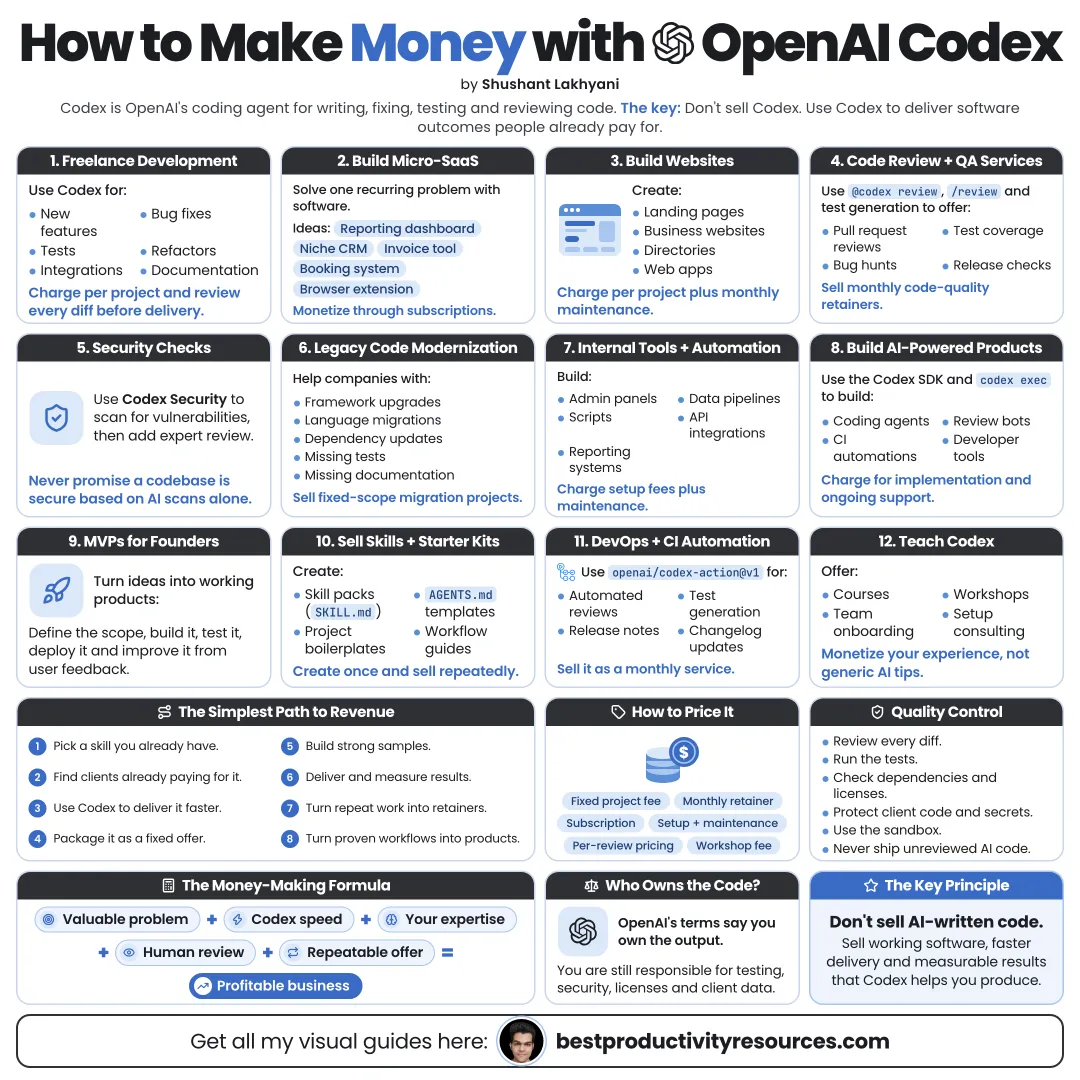
A free, practical guide to making money with OpenAI Codex: 12 business models, from websites, internal tools and automation to code review retainers, migrations, micro-SaaS and developer products, plus pricing, delivery, quality and a simple way to start.
Codex is OpenAI’s coding agent. It can read codebases, write and edit code, run tests, review pull requests, and handle longer tasks in cloud environments.
That cuts the time and cost of building software. The money is not in Codex itself. It is in solving problems people already pay to have solved.
Don’t sell “AI code.” Sell working software, time saved, and outcomes clients can rely on.
02
Know what makes Codex useful for business
Builds features from clear specs
Runs tests and fixes what fails
Reviews pull requests through @codex review
Works in cloud environments while you do other work
Runs tasks on a schedule
Follows the project rules in AGENTS.md
Reuses workflows you package as skills
Runs inside scripts and CI through codex exec
Codex comes with ChatGPT plans starting at Plus ($20/month), and Pro plans from $100/month allow heavier usage.
03
Sell websites and landing pages
Small businesses, creators, and startups still need websites that are fast and well built.
Offer:
Landing pages
Business websites
Portfolio sites
Website redesigns
Speed and accessibility fixes
Ongoing site maintenance
Charge a fixed project fee up front, then a monthly fee covering hosting help, updates, and changes.
04
Build internal tools
Plenty of teams still run on spreadsheets, copy-paste, and manual steps.
Build:
Admin dashboards
Data entry tools
Approval workflows
Reporting tools
Inventory trackers
Client portals
Spreadsheet replacements
Price on the hours the tool saves each month, not the hours you spend building it.
05
Sell automation scripts
Take repetitive work off people’s plates with scripts and small services:
File and data cleanup
Report generation
Data syncing between tools
Invoice and document processing
Scheduled exports
Notification workflows
Run scripted tasks in CI with codex exec, and keep a human signing off on anything that touches money or customer data.
06
Build MVPs for founders
Founders want to test ideas fast without hiring a whole team.
Scope the smallest build that proves the idea
Build the core workflow first
Add sign-in, payments, and analytics only when needed
Hand over with documentation
Sell paid iterations after launch
Sell speed, and be honest about it. An MVP is an experiment, not a finished company.
07
Offer code review retainers
Codex can review pull requests on GitHub and report findings in priority order.
Package a monthly service that bundles:
Automatic Codex reviews on each pull request
Your own review of the findings that matter
Security and performance checks
A monthly code-health report
Backlog recommendations
Clients pay for your judgment. Codex helps you apply it faster.
08
Sell bug-fixing and maintenance
Every product piles up bugs, outdated dependencies, and small requests over time.
Offer a monthly retainer covering:
Bug investigation and fixes
Dependency updates
Small feature requests
Test coverage improvements
Performance fixes
Error monitoring follow-up
With Codex Cloud you can run several well-scoped tasks in parallel, then review each result yourself.
09
Offer migration and modernization
Migrations are tedious and valuable, a good fit for an agent that can work through many files.
Framework upgrades
Language version upgrades
JavaScript to TypeScript
Library replacements
API version migrations
Dead code removal
Never promise a migration without tests. Write the tests first, then migrate.
10
Sell testing as a service
Many codebases have thin test coverage, so every change carries risk.
Audit critical paths with no tests
Add unit and integration tests
Fix flaky tests
Set up tests to run in CI
Document how to run the suite
Tests are simple to verify, which makes this a low-risk first offer.
11
Build and sell micro-SaaS
Build a small, focused product for one specific niche:
Niche calculators and generators
Browser extensions
Integrations linking two popular tools
Reporting tools for one industry
Simple workflow apps
Codex shortens build time, but distribution, support, and trust still decide whether anyone buys.
12
Package templates and starter kits
Package the things you keep building:
Website templates
App starter kits
Dashboard templates
AGENTS.md and skill packs for specific stacks
Automation recipes
Sell them on your own site or on marketplaces. Keep them maintained, because buyers notice when you stop.
13
Roll out Codex for teams
Many companies want agentic coding but are unsure how to roll it out safely.
Offer:
Agent-readiness audits for repositories
AGENTS.md and skills setup
Sandbox and approval policies
MCP and tool connections
Code review workflows
Team training
Sell safe adoption, not a simple install.
14
Build developer products on the Codex SDK
The Codex SDK lets your own code control local Codex agents, and the Codex App Server lets you embed Codex inside a product.
Product ideas:
Automated maintenance bots
Internal developer tools
Code quality services
Agent-powered workflows for a niche
Read OpenAI’s current terms and pricing before you build a business on any platform.
15
Create technical content
Document what you build and what you learn:
Tutorials
Build-in-public posts
Newsletters
Video walkthroughs
Courses
Workshops
Content earns trust, and trust brings clients and buyers. Teach only what you have actually done.
16
Price your work
Fixed project
Clear scope and a single price. Best for websites, MVPs, and migrations.
Retainer
A monthly fee for ongoing maintenance, reviews, and changes.
Productized service
One defined deliverable, one price, sold again and again.
Product
Templates, kits, or SaaS, sold to many buyers.
Training
Team workshops and setup.
Price the outcome and the risk you take away, not the minutes Codex spent.
17
Deliver quality work
Write a clear scope before you start
Store project rules in AGENTS.md
Commit before each task
Ask Codex for a plan before large changes
Review every diff yourself
Run tests on each change
Run /review before shipping
Document what you delivered
You answer for every line you ship, no matter who or what wrote it.
18
Protect clients and yourself
Check your plan’s data terms before touching client code
Keep secrets out of prompts and AGENTS.md
Respect the licenses of code and dependencies
Get client permission for AI-assisted work where required
Sign contracts that define scope and ownership
Run security checks before any launch
OpenAI states that Business plans do not train on business data by default. Confirm the current terms for your plan.
19
Get started
Step 1: Pick one market
Local businesses, founders, agencies, ecommerce, or a niche you already know.
Step 2: Pick one offer
A single, clear service you can deliver well.
Step 3: Build proof
Finish two or three projects, even for yourself, and record the results.
Step 4: Create a process
Capture delivery as a checklist, AGENTS.md rules, and skills.
Step 5: Package it
Fixed scope, fixed price, and a clear timeline.
Step 6: Find clients
Use your network, content, communities, and direct outreach.
Step 7: Add recurring revenue
Offer a maintenance or review retainer after delivery.
Step 8: Productize
Turn work you repeat into templates or products.
20
Apply the Codex business formula
A painful, recurring problem
+ A tightly scoped offer
+ Codex to deliver faster
+ Human testing and review
+ Clear documentation
+ A maintenance retainer
= A software business that does not rely on writing every line by hand
21
Keep expectations realistic
Codex is no guaranteed income machine.
Results depend on your market, offer, skills, distribution, and the quality of your delivery. Agents make mistakes, so review every result.
The biggest opportunity
The biggest opportunity is not reselling access to Codex. It is using Codex to deliver software people already value, faster and more reliably.
Problem
Offer
Build
Review
Deliver
Retain
Productize
Pick one market and one offer, prove it works, then turn the process into a system you can repeat.
Earnings note: nothing here promises income. Any figures or examples are illustrations, not typical results; what you earn depends on your skills, effort, market and luck, and many people earn little or nothing. This is general information, not financial, legal or tax advice. See our disclaimer.
What does “How to Make Money with OpenAI Codex” cover?
It has 21 sections, starting with “See the opportunity”, “Know what makes Codex useful for business”, “Sell websites and landing pages” and “Build internal tools”, plus 17 more sections.
How long does it take to read?
About 6 minutes. Every section is a short, self-contained card, so you can jump straight to the part you need.
Is this guide free?
Yes. The full guide is free to read on this page, with no sign-up.
For research and ideas only. Results vary and nothing here is a promise of income. See our Disclaimer.
See you Monday!
Weekly newsletter
Everything new, every Monday.
One short email every Monday with everything shipped that week: new free tools and websites, new guides, new free browser tools and what's new in my free Gumroad libraries, plus how the site is growing. Free, and you can unsubscribe anytime.
You sign up on Gumroad, which stores your email to send the newsletter. See our Privacy Policy.
Cookies and your choices
Visits are counted by Cloudflare Web Analytics, which sets no cookies and stores nothing on your device. An affiliate tracking script from Impact.com also loads on our pages and can set its own cookies so partner companies can credit us for sign-ups. Essential storage is always on so pages load and work correctly. You decide whether your browsing preferences are saved on your device. Read the Privacy Policy.