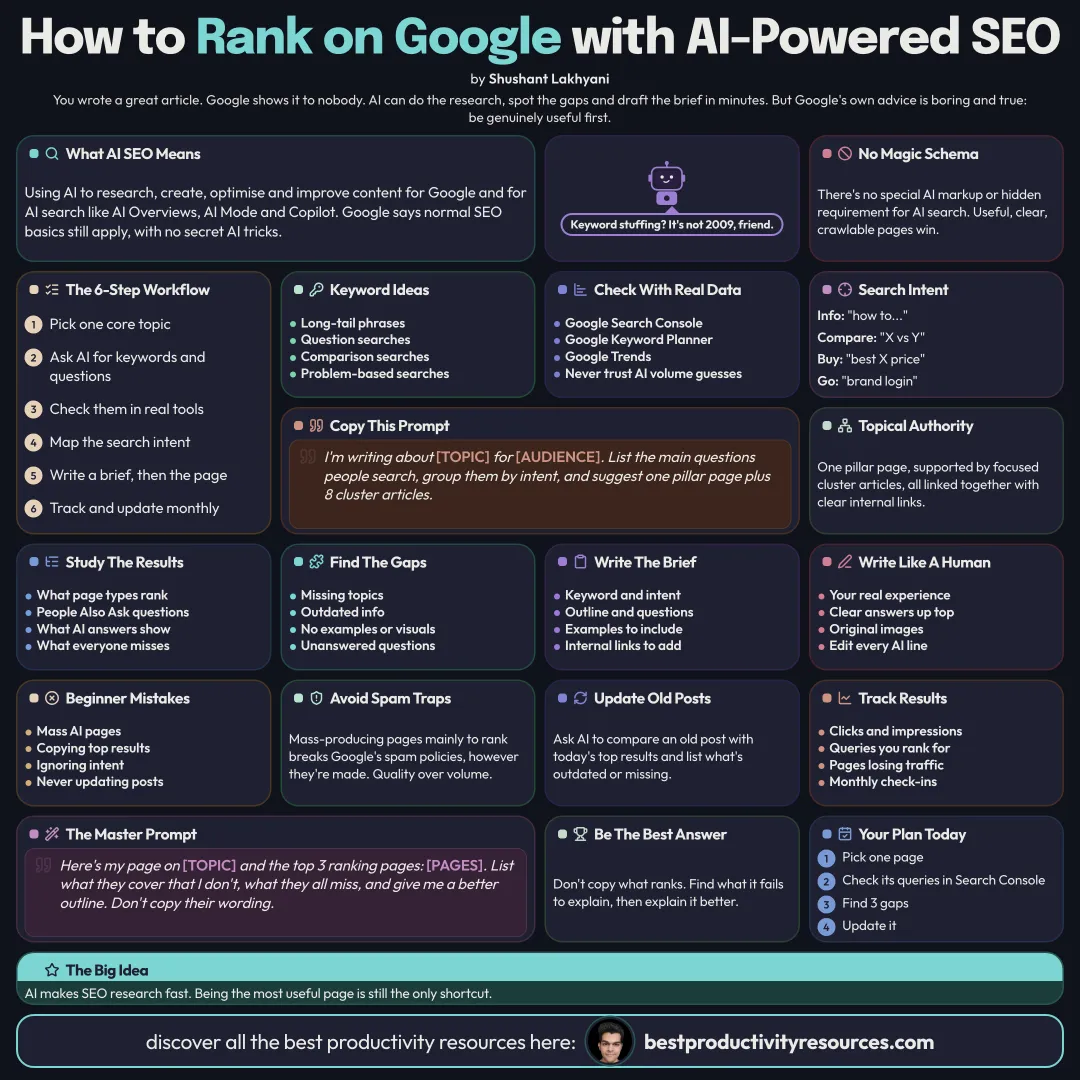
A practical system for AI-powered search optimization
28 bite-sized sections
8 min read
Free, no signup
Short answer
A complete guide to using AI for SEO: keyword research, search intent mapping, topical authority, SERP analysis, content briefs, content creation, optimization, internal linking, technical SEO, schema markup, programmatic SEO, refreshes, data analysis, link-building research, AI search visibility and measuring what matters.
AI SEO means using artificial intelligence to research, create, optimize, analyze, and improve content for traditional search engines and AI-powered search experiences.
SEO is no longer only about ranking blue links. Your content can also surface in AI Overviews, AI Mode, Copilot, and other AI-generated search experiences.
Google's current guidance is clear: traditional SEO fundamentals still apply to generative AI search. You need no special AI schema or secret technical setup to appear in AI Overviews or AI Mode.
02
Research keywords with AI
Use AI to expand broad topics into full sets of search opportunities.
Ask AI to list:
Primary keywords
Long-tail keywords
Question keywords
Commercial keywords
Informational keywords
Comparison keywords
Problem-based searches
Related entities
Subtopics
Content gaps
Then check important keywords against real search and SEO data. Do not trust search volumes that AI estimates.
AI can sort keywords by what the searcher really wants.
Common intent types:
Informational
Navigational
Commercial investigation
Transactional
Local
Ask AI:
What problem is this searcher trying to solve?
What information does the searcher expect?
Which content format best fits this query?
What should this page help the searcher achieve?
Build each page around intent, not keyword density.
04
Build topical authority
Stop publishing isolated articles. Pick one core topic and use AI to map all of it.
Use AI to identify:
Main topic
Subtopics
Supporting questions
Definitions
Comparisons
Use cases
Alternatives
Problems
Solutions
Examples
Related concepts
Build pillar pages, back them with focused cluster content, and connect them with relevant internal links.
05
Analyze search results
Pair AI with live SERP and SEO data to see what performs right now.
Analyze:
Ranking page types
Common topics covered
Content depth
Search intent
Titles
Headings
Featured snippets
People Also Ask questions
Videos
Forums
Images
AI-generated results
Competitor strengths
Competitor weaknesses
Never copy ranking pages blindly. Find what they leave unexplained and publish something more useful.
06
Find content gaps
Give AI competitor pages, keyword exports, or SEO datasets, then ask it to spot:
Missing topics
Weak explanations
Unanswered questions
Outdated information
Missing examples
Missing statistics
Missing visuals
Missing comparisons
Missing use cases
Turn each gap into a content opportunity your competitors do not cover.
07
Create SEO content briefs
Before you write, have AI draft a structured brief that covers:
Target keyword
Search intent
Target audience
Primary problem
Secondary keywords
Related entities
Questions to answer
Suggested title
Heading structure
Examples needed
Original research opportunities
Internal-link opportunities
Recommended visuals
Conversion goal
Use the brief as a research framework, not a rigid template.
08
Draft content with AI support
AI can help you produce:
Article outlines
First drafts
Introductions
Definitions
FAQs
Examples
Product descriptions
Category descriptions
Landing pages
Comparison pages
Glossaries
Scripts
Supporting copy
Let AI speed up your expertise, never replace it. Add:
Original insights
First-hand experience
Expert commentary
Unique examples
Original research
Screenshots
Experiments
Data
Case studies
Useful visuals
Google warns that mass-producing AI-generated pages with no meaningful added value can break its scaled content abuse policies.
09
Upgrade existing pages with AI
Give AI an existing page and ask it to flag:
Missing information
Weak sections
Outdated claims
Poor organization
Search-intent mismatch
Repetitive sections
Unclear explanations
Missing entities
Internal-link opportunities
Poor headings
Then fix what is weak. Do not rewrite the whole page by default.
10
Sharpen titles and meta descriptions
Have AI draft several versions of:
SEO titles
Meta descriptions
H1 headings
Social titles
Image alt text
Aim for relevance, clarity, specificity, and usefulness. Skip misleading clickbait and keyword stuffing.
11
Improve content structure
Make every page easy for people and search systems to understand.
Clear H1
Logical H2s and H3s
Short readable sections
Descriptive headings
Lists when useful
Definitions
Examples
Supporting evidence
Relevant images and videos
Clear internal links
Put important information in accessible text, not only inside images or interactive elements.
12
Strengthen internal links with AI
Give AI your sitemap or URL list and ask it to find:
Relevant pages to connect
Orphan pages
Weakly linked pages
Contextual anchor opportunities
Topic clusters
Pillar pages
Make sure crawlable internal links lead to every important page.
13
Diagnose technical SEO with AI
AI can help you analyze:
Crawl errors
Indexation problems
Canonical issues
Redirect chains
Broken links
Duplicate pages
Robots.txt
XML sitemaps
Structured data
JavaScript SEO problems
Page templates
Core Web Vitals data
Server logs
AI shines at explaining technical reports and suggesting possible fixes. Test every technical change before you deploy it.
14
Generate schema markup with AI
AI can help you write fitting structured data, such as:
Article
Product
Organization
LocalBusiness
BreadcrumbList
Event
VideoObject
Recipe
Add only structured data that matches visible page content and meets Google's requirements.
Google's AI Overviews and AI Mode require no special schema of their own.
15
Scale programmatic SEO with care
AI can help you build pages at scale from structured datasets.
Examples:
Location pages
Integration pages
Directory pages
Comparison pages
Template libraries
Product databases
Every generated page still needs real standalone value. Thousands of near-identical AI pages built mainly to game rankings can cause serious SEO and spam-policy problems.
16
Refresh aging content with AI
AI can check old content against current information and flag:
Outdated statistics
Old product information
Broken references
Missing developments
Changed recommendations
New competitors
New questions
Sections that need expansion
Refresh pages that already earn impressions, backlinks, traffic, or conversions first.
17
Analyze SEO data with AI
Export data from Google Search Console, Google Analytics, Ahrefs, Semrush, Bing Webmaster Tools, and your CMS.
Use AI to analyze:
Traffic changes
Ranking changes
CTR
Impressions
Conversions
Page performance
Keyword clusters
Content decay
Cannibalization
High-impression low-CTR pages
Pages near page-one rankings
Emerging topics
Let AI surface patterns, anomalies, and opportunities so you do not have to scan thousands of rows by hand.
18
Research link-building with AI
AI can help you find:
Linkable assets
Relevant publications
Resource pages
Industry websites
Unlinked brand mentions
Broken-link opportunities
Digital PR angles
Original research ideas
Expert commentary opportunities
Use AI for research and personalization. Avoid automated spam outreach and manipulative link schemes.
19
Optimize for AI SEO
AI SEO means making your content easier to find in traditional search and in AI-generated search experiences.
Depending on the industry, people call this:
AI SEO
AEO (Answer Engine Optimization)
GEO (Generative Engine Optimization)
Google currently treats optimizing for its generative search experiences as part of SEO, not as a separate discipline.
20
Create AI-friendly content
AI search systems need useful information they can retrieve and understand. Publish content with:
Clear answers
Strong topical relevance
Accurate facts
Specific examples
Original insights
First-hand experience
Expert knowledge
Supporting evidence
Clear headings
Useful images and videos
Logical site architecture
Current information
Skip generic summaries that only repeat what is already available everywhere.
21
Cover the full user journey
AI-powered search can split a complex question into several related searches. Do not optimize for one exact keyword alone.
Answer related questions, such as:
What is it?
How does it work?
Who is it for?
How do I use it?
What does it cost?
What are the benefits?
What are the limitations?
What are the alternatives?
How does it compare?
Which mistakes should you avoid?
Broader topical coverage raises the number of relevant queries your content can potentially answer.
22
Make your content crawlable
AI optimization cannot make up for weak technical SEO. Confirm that:
Key pages are crawlable
Key pages are indexable
Robots.txt is set up correctly
Canonical URLs are correct
XML sitemap is up to date
Internal links are crawlable
Important text is accessible
Pages work on mobile
Pages load efficiently
Duplicate URLs are under control
To show up in Google's generative Search features, pages generally must be indexed and eligible to appear in Google Search with snippets.
23
Optimize for multimodal search
Search now spans text, images, video, camera-based queries, and other multimodal experiences.
Improve:
Original images
Image quality
Descriptive filenames
Alt text
Surrounding text
Video content
Video titles
Captions
Relevant visual context
Google Search Console now reports on web multimodal search, including searches through Lens, Circle to Search, image uploads, and related experiences.
24
Earn brand and trust signals
AI cannot fake real authority. Earn it through:
Expert authors
Clear author information
Original research
First-hand experience
Accurate citations
Transparent company information
Strong reputation
Useful products
Industry mentions
Relevant backlinks
Consistent expertise
Tie your brand to the topics you want to own.
25
Measure AI search visibility
Rankings alone do not define success. Track:
Organic clicks
Organic impressions
CTR
Conversions
Indexed pages
Keyword visibility
AI citations
Pages cited by AI
AI visibility trends
Grounding queries
Branded searches
Assisted conversions
Google Search Console now includes dedicated Generative AI performance reporting for visibility in Google's generative Search features.
Bing Webmaster Tools also offers AI Performance reporting that covers citations across Microsoft Copilot, AI-generated Bing experiences, and supported partner experiences.
Research → Plan → Create → Optimize → Publish → Index → Measure → Analyze → Improve → Refresh
The golden rule
Do not use AI to publish more content. Use AI to publish better content, faster.
AI speed
Human expertise
Original information
Technical SEO
Strong user experience
Real-world evidence
Continuous measurement
AI can speed up almost every part of SEO. Useful, accurate, original, crawlable, people-first content is still what earns visibility in traditional and AI-powered search.
It has 28 sections, starting with “Understand what AI SEO is”, “Research keywords with AI”, “Map search intent” and “Build topical authority”, plus 24 more sections.
How long does it take to read?
About 8 minutes. Every section is a short, self-contained card, so you can jump straight to the part you need.
Is this guide free?
Yes. The full guide is free to read on this page, with no sign-up.
For research and ideas only. Results vary and nothing here is a promise of income. See our Disclaimer.
See you Monday!
Weekly newsletter
Everything new, every Monday.
One short email every Monday with everything shipped that week: new free tools and websites, new guides, new free browser tools and what's new in my free Gumroad libraries, plus how the site is growing. Free, and you can unsubscribe anytime.
You sign up on Gumroad, which stores your email to send the newsletter. See our Privacy Policy.
Cookies and your choices
Visits are counted by Cloudflare Web Analytics, which sets no cookies and stores nothing on your device. An affiliate tracking script from Impact.com also loads on our pages and can set its own cookies so partner companies can credit us for sign-ups. Essential storage is always on so pages load and work correctly. You decide whether your browsing preferences are saved on your device. Read the Privacy Policy.